Facts about Housekeepers
Understanding the role of a housekeeper can be helpful for households considering domestic staff as well as for those interested in a career in housekeeping. Professional housekeepers play an important role in maintaining private homes, ensuring cleanliness, organisation and smooth daily routines.
Below are some interesting facts about housekeepers, housekeeping work and the role domestic staff play in modern households.
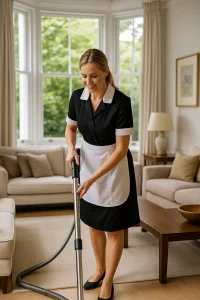
A professional housekeeper cleaning a living room in a private household.
Top 10 facts about housekeepers
-
Housekeepers are responsible for maintaining the cleanliness and organisation of private homes and reporting any safety concerns to the homeowner or house manager.
-
Typical tasks include vacuuming, sweeping, dusting, mopping floors, cleaning bathrooms and maintaining kitchens.
-
Some housekeepers may also assist with laundry, ironing and household organisation.
-
In certain households, housekeepers may also help with light childcare if they have relevant experience.
-
Housekeepers may work live-in or live-out, depending on the household’s requirements.
-
Experienced housekeepers in London typically earn around £45,000–£50,000 per year, depending on experience and responsibilities.
-
Many housekeepers take pride in maintaining high cleaning standards and attention to detail.
-
London remains one of the most popular locations in the UK for professional housekeepers to work.
-
Long-term placements are common, with some housekeepers remaining with households for many years.
-
Housekeepers may work full-time or part-time in private households depending on the needs of the client.
A professional housekeeper preparing a bedroom in a private household.
Interesting facts about housekeeping
Housekeeping requires organisation, time management and attention to detail. Professional housekeepers develop efficient cleaning routines and systems to maintain homes to a high standard. Below are some interesting facts about cleaning and housekeeping.
These facts about housekeeping may encourage some households to spend more time maintaining their homes — or to consider hiring professional help.
Interesting cleaning facts from professional housekeepers
• The kitchen sink is often one of the dirtiest places in the home because moisture and food particles allow bacteria to grow easily.
• Kitchens are often the most bacteria-prone rooms in a house due to food preparation and moisture.
• Household dust contains many particles, including fibres, hair and skin cells.
• Cleaning removes dirt and visible debris, while disinfecting helps eliminate bacteria and germs.
• Many couples report that cleaning and household chores are a common source of disagreement.
Cleaning facts shared by professional housekeepers
- Baking soda can help absorb unwanted odours in refrigerators.
- Vinegar is often used as a natural degreaser for kitchen cleaning.
- Washing machines can be used to clean certain household items such as shower curtains.
- Essential oils placed inside a toilet paper roll can help lightly scent a bathroom.
Interesting statistics about household cleaning
Maintaining a clean and organised home is important not only for presentation but also for health and indoor air quality.
• Indoor air can sometimes be more polluted than outdoor air if homes are not cleaned regularly.
• Carpets can hold large amounts of dust and allergens if not vacuumed frequently.
• Many people report cleaning more thoroughly when guests are expected.
• Kitchen cloths and sponges can contain significant amounts of bacteria if not replaced regularly.
More cleaning statistics
Almost half of all people do not use soap to wash their hands in a public bathroom. After thoroughly washing your hands with soap in a public bathroom, grab an extra paper towel to turn off the faucet and open the door to avoid touching contaminated surfaces.
As a matter of fact, 78% of people clean behind and underneath furniture. The other 22% should follow their example, as dust and dirt accumulate in these hard-to-reach places.
Interestingly, 35% of people are motivated to clean after they smell something unpleasant. Waiting until odours develop allows bacteria more time to grow and makes cleaning more difficult.
Hiring a professional housekeeper
For households that prefer professional support with cleaning and household organisation, hiring an experienced housekeeper can be a practical solution. A professional housekeeper ensures that homes remain clean, organised and ready for everyday life.
Working with a specialist housekeeper agency in London can help households find experienced candidates suited to their home and lifestyle.