By Sara Vestin Rahmani, Founder and Owner of Bespoke Bureau and The British Butler Academy · 16 November 2026
A beautifully maintained home depends on hundreds of decisions made throughout the working day. Which product is suitable for a particular surface? How should a delicate garment be handled? What needs attention before guests arrive, and which tasks can wait?
These decisions require knowledge, experience and judgement. The person making them deserves clear expectations and the resources to carry out the work properly.
For private employers, house managers and family offices supporting staffed residences, investing in a housekeeper’s professional knowledge is a practical way to support the care of the home.
Good standards need to be understood
“Keep everything immaculate” expresses an expectation, but gives very little guidance.
A housekeeper also needs to understand the household’s priorities: which rooms are occupied at different times, how the family prefers its belongings arranged, what should remain undisturbed and where particular care is required.
Even an experienced professional arriving in a new position needs this information. A method or routine that worked well in one home may need adapting in another.
A useful starting point is to explain three things clearly: the result you expect, any care requirements that must be followed and the household preferences that make the service personal.
For example, the preferred arrangement of bed linen is a presentation choice. The washing and drying requirements of that linen depend on its care instructions. Both matter, and a housekeeper needs to understand the distinction.
Clothing deserves particular attention
Laundry and wardrobe care can be especially sensitive areas of private household work.
Clothing represents a person’s taste, identity and public presentation. A garment may have been made to measure, purchased for an important occasion or kept for sentimental reasons. Its significance cannot always be understood from its appearance or price.
Fine fabrics, intricate construction, embellishments and specialist finishes require informed care. Haute couture and other valuable garments may also involve substantial expenditure and skilled craftsmanship.
A professional housekeeper needs the confidence to recognise when an item requires further guidance or specialist attention. Employers can support that judgement by making garment-care instructions and established arrangements with specialist cleaners available.
Time matters here, too. Careful inspection, preparation and finishing need to be reflected in the working schedule.
Experience benefits from continued learning
Experienced housekeepers bring valuable practical knowledge. Continued learning gives them a way to extend that knowledge as homes, materials and responsibilities change.
A new position may involve unfamiliar finishes, different laundry equipment or a wardrobe with more demanding care requirements. Progression to head housekeeping introduces further responsibilities: organising work, guiding colleagues, reviewing presentation and arranging clear handovers.
A professional reference offers somewhere to revisit a process, examine the reasoning behind a method or prepare for a conversation about how a task should be approached.
Providing that resource can be a constructive expression of support for someone’s professional development.
For further professional development, explore the British Butler Academy’s practical training courses and online courses. You may also find it useful to read my article on whether experience makes you a better housekeeper.
Make learning part of the working routine
A book becomes more useful when there is time to apply its guidance thoughtfully.
An employer or house manager might begin by choosing one relevant subject with the housekeeper: laundry organisation, room preparation or planning weekly cleaning tasks.
Read the relevant guidance, discuss how it relates to the home and identify a manageable improvement. Review the result after the revised routine has been used.
For a new employee, this approach can support induction. For an established housekeeper, it provides a focused way to refine a particular area of work without making every conversation about a mistake.
Practical records should serve the household. A smaller home may need a straightforward schedule and a few clear care notes. A larger residence may require more detailed inventories, handovers and task records.
A reference that supports the individual home
Professional guidance works alongside the household’s own instructions, manufacturers’ care requirements and specialist advice.
Each home still needs to communicate its preferences, priorities and working arrangements. The purpose of a handbook is to give readers a stronger foundation for understanding and carrying out their responsibilities.
The Professional Housekeeper Handbook — Fourth Edition
That is the thinking behind the Fourth Edition of The Professional Housekeeper Handbook.
Drawing on more than 23 years in private household recruitment and professional training, I have brought together detailed guidance on cleaning, surface care, laundry, ironing, wardrobe organisation, guest preparation and finishing touches, alongside the responsibilities of head housekeeping.
The downloadable PDF includes 18 practical resources, with completed examples and blank working forms, together with a clickable contents page and alphabetical index.
I believe housekeeping deserves to be recognised as a skilled profession. Supporting the people who do this work—with clear expectations, useful knowledge and time to exercise care—is part of maintaining a home well.
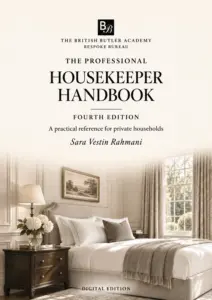
The Professional Housekeeper Handbook — Fourth Edition by Sara Vestin Rahmani: a practical reference for the care of private homes.
You can also explore our wider collection of professional training handbooks for private service and hospitality.
Get Your Copy of the Handbook
A downloadable PDF with detailed guidance on the care of private homes and 18 practical resources. £299.